

2026 Keyword research is not necessarily about ranking for the popular keyword, but ranking for specific user queries that are often neglected.
The first step to SEO is finding what to rank for. Keyword Research is the process of discovering the specific words and phrases people type into search engines to find information, products, or services.
What are Keywords?
A keyword is a word or group of words people write when searching. For example, “Samsung”, “solar”, “3kva solar system installation”, “How to rank on Google”.
If the same (or similar) keyword is found on your site, it’s more likely to appear in search results. The position you’re placed in the SERPs doesn’t solely depend on the keyword, but on various SEO factors combined.
Keywords represent the language of the customer. If your website speaks the same language as your target audience, search engines like Google can accurately match your pages to their needs.
A Brief Background of Keywords
In the early days of the web (the 1990s), keyword research was primitive. Search engines relied heavily on keyword density—the more times you mentioned a word, the higher you ranked. This led to “keyword stuffing,” which created a poor user experience.
Today, search engines use sophisticated methods such as NLP (Natural Language Processing) and LSI when looking at keywords. They no longer just look for exact matches; they look for context, synonyms, and the relationship between words to understand the “topic” of a page rather than just the “term.”
Types of Keywords
Understanding the structure of keywords helps in prioritizing which ones to target:
- Short-Tail Keywords: Broad, one or two-word terms (e.g., “shoes”, “solar”, “furniture”). Short-tailed keywords are generic. For example, the keyword “solar” can result in solar products and Wikipedia explaining solar. These keywords have high search volume but massive competition and low conversion rates. You don’t want to compete with Wikipedia.
- Long-Tail Keywords: Phrases containing three or more words (e.g., “waterproof trail running shoes for men”, “3kva solar system installation Harare” , “L shaped couch for sale Harare”). These have lower volume but much higher conversion rates because they are specific and narrow.
- LSI Keywords: Related terms that help define context (e.g., if your keyword is “Apple,” LSI keywords like “iPhone,” “orchard,” or “Steve Jobs” tell Google which “Apple” you mean).
Understanding Keyword Intent
Not all searches are created equal. Identifying User Intent is the most critical step in modern SEO. Intent generally falls into four categories:
- Informational: The user is looking for an answer (e.g., “How to fix a leaky tap”).
- Navigational: The user wants to find a specific site (e.g., “Facebook login”).
- Commercial: The user is researching before buying (e.g., “Best laptops for developers 2026”, “Samsung vs iPhone camera”).
- Transactional: The user is ready to buy (e.g., “Buy MacBook Pro M4”, “headboards for sale in Harare”).
You’ll need to ensure your content aligns with what users are searching for. For example, for a transactional keyword like “Buy MacBook Pro M4”, users expect to find price, product description, and product images. If these are absent, your page won’t rank well.
To find out the intent, insert the keyword in Google search and observe the type of content being displayed. If Google is showing blogs, create an article. If showing products, you need product pages, showing videos, put video content, etc.
Finding Keywords
Generating a list of potential keywords requires a blend of intuition and data.
1. Industry Knowledge
Start with “Seed Keywords.” These are the core topics your business covers. You need to know what people in your niche struggle with.
Think of what someone may input in the search bar. For example, for a web development users might search for “web designer Harare”, “what is web hosting”
- Brainstorming: What questions do customers ask you? Create articles or FAQs (Frequently Asked Questions) answering those questions,
- Competitor Analysis: What topics are your successful competitors writing about?
- Forums & Communities: Check Facebook comments, Reddit, Quora, or industry-specific forums to see how real people describe their problems.
2. Using Tools
Once you have your seeds, use tools to find the data behind them. Some tools give you Free data with the option to upgrade.
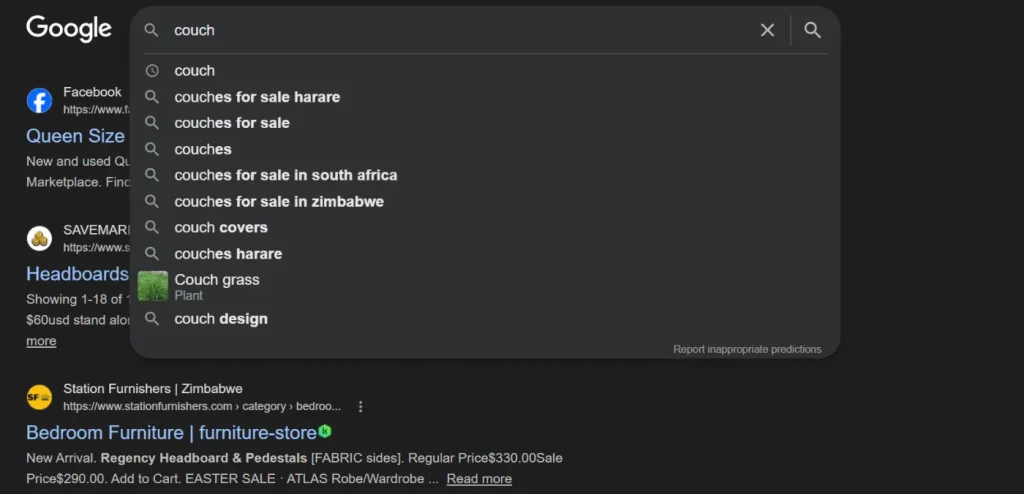
- Google/ BingSuggest: The simplest method of finding keywords. Type a term into the search bar and see what auto-completes. You can also take questions from the “People Also Ask” section.
- Wordstream: Wordstream free keyword tool gives you a list of keywords, search volume, and ranking difficulty.
- Ahrefs free keyword generator: Shows you limited keywords, volume and their respective difficulty.
- Answer the Publichttps://answerthepublic.com/: Great for finding question-related keywords.
- Google Keyword Planner: Great for finding search volume and commercial “bid” data. This requires a Google ad account
Use tools in conjunction with your industry knowledge otherwise, you may end up stuffing keywords just to rank.
Assessing Keyword Profitability
A keyword with 10,000 searches a month isn’t necessarily better than one with 100. A keyword may be searched by a few people but yield serious buyers or converts better.
To assess profitability, look at:
- Cost Per Click (CPC): If advertisers are willing to pay $5 per click for a term, that term likely leads to sales.
- Competition (Difficulty): Can you realistically rank for this? If the top 10 results are all massive global brands, your ROI might be better spent on “long-tail” alternatives.
While most people want to rank for big keywords, which is difficult, it’s better to focus on specific user queries and create content around those.
Most of the websites I’ve done SEO on usually rank for long-tailed keywords.
How & Where to Place Keywords
Once you have your keywords, you must place them strategically to signal relevancy to search engines without sacrificing readability.
| Element | Best Practice |
| Title Tag | Place the primary keyword as close to the beginning as possible. |
| H1 Header | Ensure your main heading matches the user’s search intent. |
| First 100 Words | Use the primary keyword early to establish the topic immediately. |
| Subheadings (H2, H3) | Use variations and LSI keywords here to provide structure. |
| URL Slug | Keep it short and include the main keyword (e.g., /keyword-research-guide/). |
| Alt Text | Describe images using keywords where it makes sense for accessibility. |
Keyword research is not difficult if you know your niche inside and out. You know their problems and questions and can create content around that.
The Golden Rule: Always write for humans first and search engines second. Don’t stuff keywords by putting them where they don’t belong.
This page was written with the assistance of AI. Read more about our AI usage policy