

If you want to get traffic to your website, you need to focus on SEO.
Here are some SEO statistics that show the real value of SEO.
This guide will walk you through the basics of SEO and why it’s the most powerful tool in your digital marketing arsenal.
I encourage you to read all the articles in this Hub
What Exactly is SEO?
SEO stands for Search Engine Optimization. It is the process of improving your website to increase its visibility when people search for products or services related to your business in Google, Bing, and other search engines.
The goal is simple: Rank as high as possible. 75% of people don’t get past the first page of search results; thus, you need to make sure you appear on the first page (at least)
How Search Engines Work
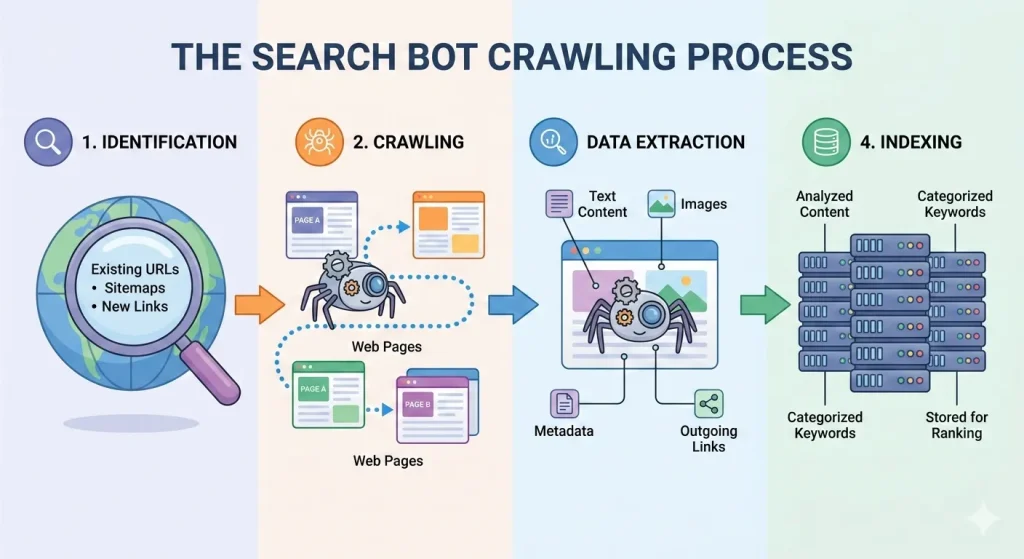
Before you can optimise, you need to understand the steps search engines take:
- Crawling: Search engines send out “spiders” (bots) across the web to find new and updated content.
- Indexing: They store and organize that content in a giant database.
- Ranking: When a user types a query, the engine pulls the most relevant, high-quality content from its index to show the user.
When you create a website, you need to submit it to search engines for crawling. Each search engine (Google, Bing) provides interfaces where you can submit and manage your site’s rankings. For Google, you submit to Google Search Console, and for Bing, you use Bing Webmaster Tools.
The Three Pillars of SEO
To master the basics, you need to look at SEO through three distinct lenses.
2. Keyword Research
Finding the terms people actually type into Google.
Find the intent behind searches.
2. On-Page SEO
This is everything you do on your website to help search engines understand your content.
- Content Quality: Writing helpful, original, and engaging articles. Google’s emphasis is EEAT: Experience, Expertise, Authority, and Trust.
- Title Tags & Meta Descriptions: The snippets that show up in search results.
- Header Tags (H1, H2): Organizing your content so it’s easy to read.
- Internal linking: Linking web pages with one another on the same site.
3. Off-Page SEO
This refers to actions taken outside of your own website to impact your rankings.
- Backlinks: When other reputable websites link to yours, it acts as a “vote of confidence.”
- Social Media Marketing: Driving traffic and brand awareness through social channels.
- Guest Posting: Writing for other blogs to build authority.
- Local Citations: Having your website or business name mentioned in forums, reviews, or listings.
4. Technical SEO
This focuses on the “under the hood” elements that help bots crawl and index your site effectively.
- Site Speed: Google hates slow websites.
- Mobile-Responsive Your site must look great and usable on a phone.
- Site Architecture: Having a logical structure and a secure connection (HTTPS).
Local SEO
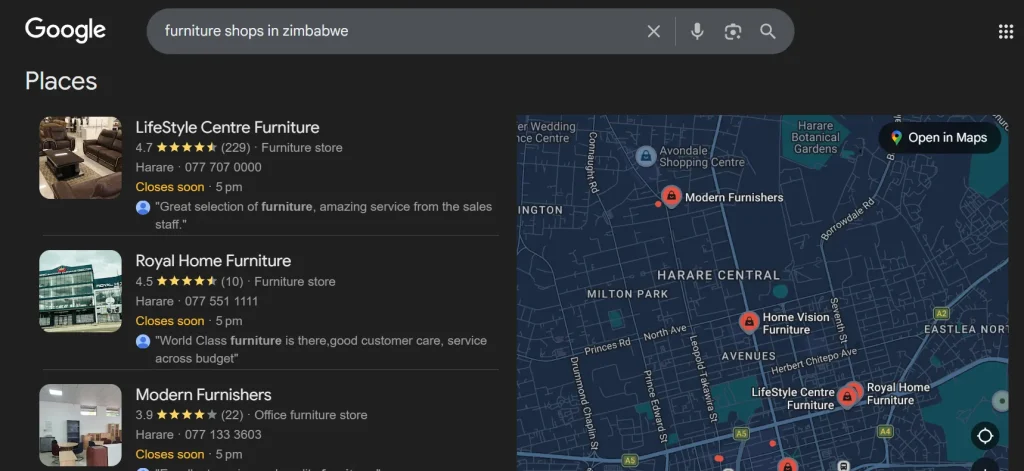
There’s another sub-category of SEO known as local SEO. This involves ranking websites in local searches and for keywords such as “…in Harare”, “…near me” searches. It also involves optimisng Google Business Profiles to appear in the local business pack.
Why Should You Care About SEO?
You might be thinking, “Can’t I just pay for ads?” You can (that’s called SEM), but SEO offers benefits that paid ads cannot
Understanding Inbound Marketing
To understand SEO you need to look at it from an inbound marketing angle.
Inbound marketing focuses on attraction and making your brand, products, or services findable.
With inbound marketing, you don’t go after people; they come to searches looking for products, services, or content.
It is different from Outbound marketing where you push a product/service to people through Ads.
When an Ad ends, leads also stop coming in. However, with SEO, once a website ranks, you get leads for a long period of time without spending a dime.
Here’s a full table breakdown of the benefits of SEO(Inbound) compared to Paid Ads(Outbound)
| Feature | Organic SEO | Paid Search (PPC) |
| Cost | “Free” (requires time/effort) | You pay for every click |
| Longevity | Results compound over time | Traffic stops when you stop paying |
| Trust | Users trust organic results more | Users often skip over “Ad” labels |
| ROI | Higher long-term ROI | Great for short-term bursts |
3 Quick Tips for Beginners
- Write for Humans, Not Robots: Google’s algorithms are smart. If you “stuff” keywords into a sentence until it sounds robotic, you will be penalised. Focus on providing value.
- Know your niche: Know how people in your industry search, and the words they use when searching
- Use Tools: Use tools like Google Search Console, Ahrefs, or Semrush to see what’s working.
- Be Patient: You don’t see results overnight. It usually takes 3 to 6 months to see significant movement in rankings.
Summary
SEO is about being the best answer to a user’s question. By optimising your on-page content, making your site crawlable, and building your reputation online, you’ll climb the rankings and grow your business sustainably.
This page was written with the assistance of AI. Read more about our AI usage policy